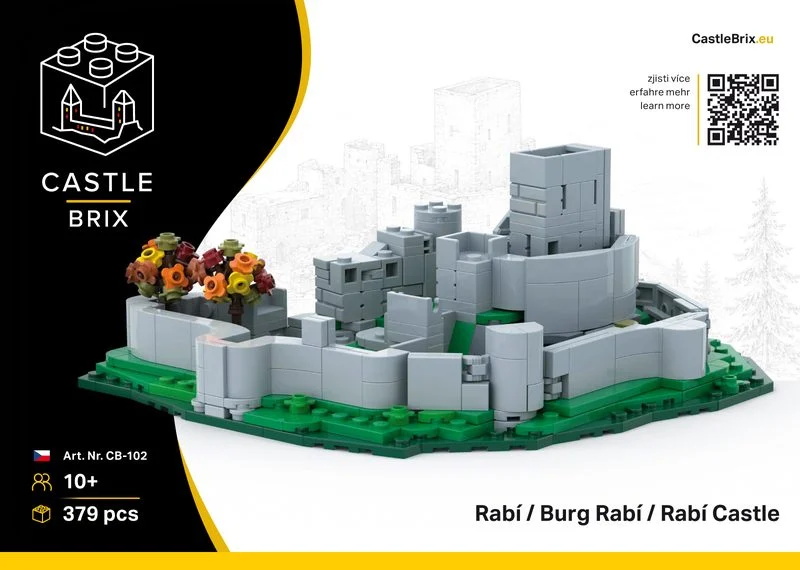
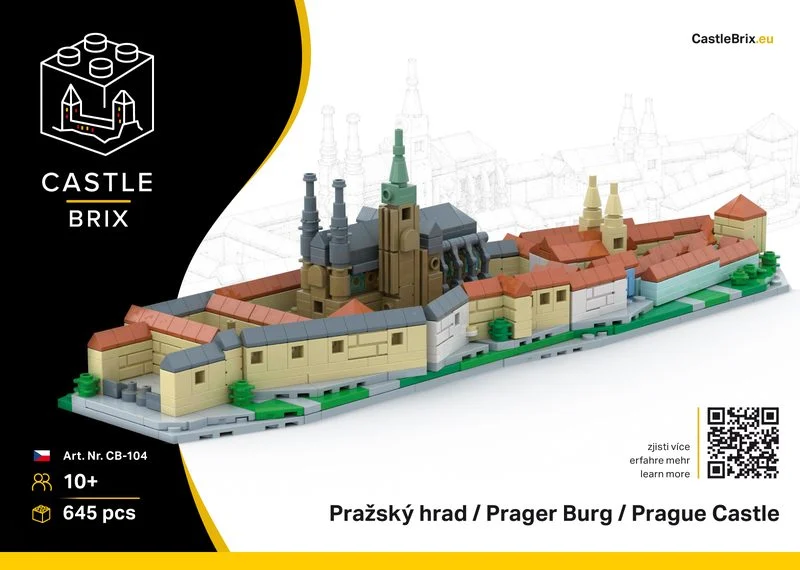
Kašperk Castle
Hrad Kašperk / Burg Kašperk
CastleBrix Connect / official digital guide to model kit 103
Velhartice was built at the turn of the 13th and 14th centuries as the family seat of the lords of Velhartice. Its distinctive appearance is created by the Paradise Palace (Rajský palác), the massive residential and defensive tower Putna and, above all, the 32-metre stone bridge that links the two buildings. In the 15th century, the Bohemian crown jewels were even secretly hidden at the castle.
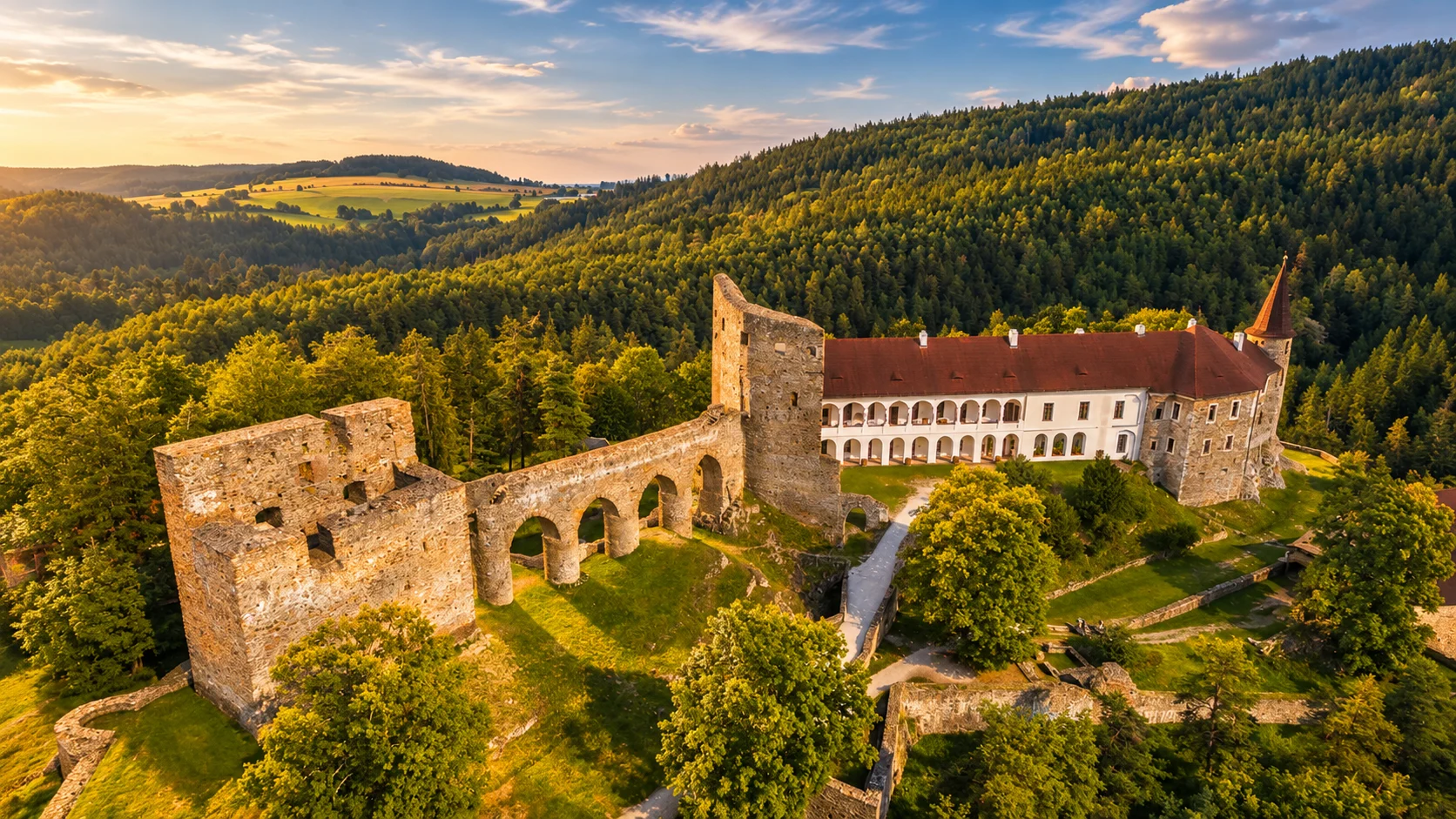
On the rocky spur above the Ostružná valley, the seat of the lords of Velhartice takes shape. From the original fortified site, a castle with two stone palaces gradually emerges.
After the original family dies out, Velhartice passes by marriage to John of Hradec. His son Menhart later becomes one of the most powerful men in the Kingdom of Bohemia.
Menhart of Hradec, an opponent of George of Poděbrady, has the Bohemian crown jewels secretly hidden at Velhartice. His aim is to prevent George's coronation as King of Bohemia.
After the Thirty Years' War, Velhartice is acquired by the imperial officer Martin de Hoeff Huerta. In the upper courtyard he has a new late Renaissance palace built, which markedly changes the appearance of the castle core.
Today Velhartice combines a medieval castle, a Renaissance palace, a former brewery and an open-air museum of folk architecture. The most striking symbol of the site remains the combination of the Paradise Palace, the stone bridge and the Putna.
By Czech standards, Velhartice has a remarkably unusual layout. The castle core consisted of two palaces, later joined by a forward defensive tower. Between the palace and the tower rose a structure that today defines the whole character of the castle.
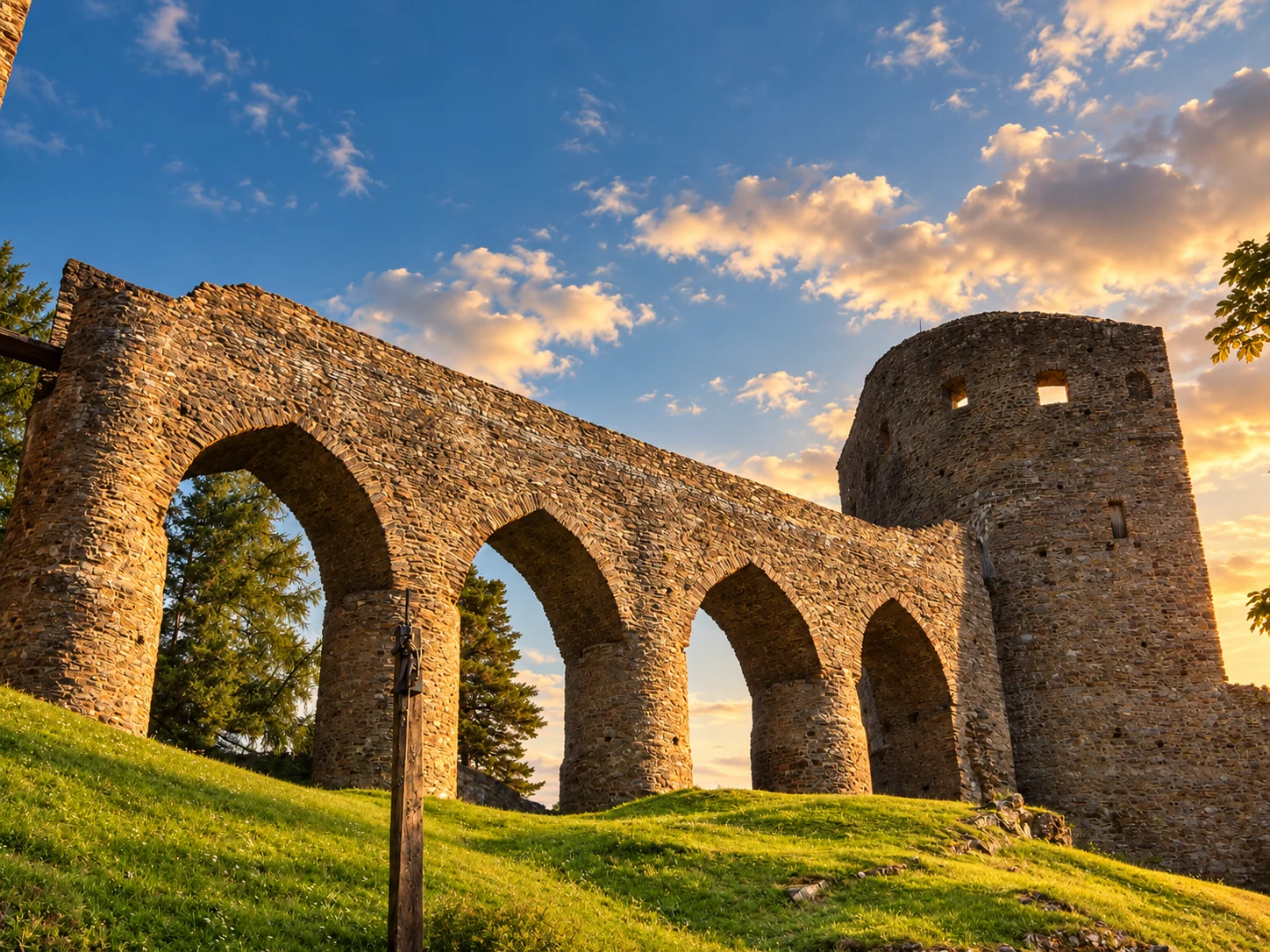
The stone bridge at Velhartice is 32 metres long, about 3 metres wide and almost 10 metres high. Four pointed arches rest on massive cylindrical piers. It was more than a mere link – the bridge formed part of the defensive system and could be closed off at both ends by drawbridges. According to the castle administration, this structure has no equivalent among the castle complexes of Central Europe. hrad-velhartice.cz
The massive rectangular Putna tower protected the easily accessible north-western front of the castle. Its walls are more than 2.5 metres thick, and originally it could not be entered from ground level at all. Access led from the bridge straight into the upper storey. If the enemy took the palace, the defenders could retreat across the bridge into the tower and carry on the fight from there. hrad-velhartice.cz
Model CB-103 preserves precisely the most characteristic composition of Velhartice: the elongated Paradise Palace, the striking stone bridge and the massive Putna at its far end. Thanks to the distinctly elongated 31 × 7 cm format, the real spatial logic of the castle remains clearly legible.
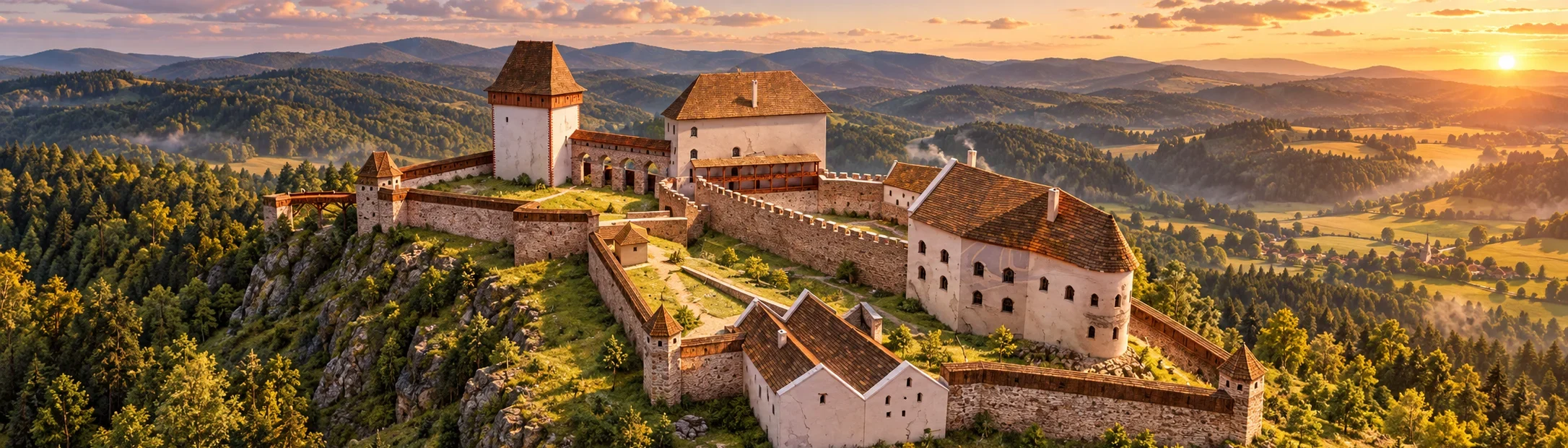
In the 15th century, Velhartice belonged to Menhart of Hradec, High Burgrave of the Kingdom of Bohemia. As an opponent of George of Poděbrady, he used his access to the crown jewels and had them secretly moved to Velhartice to complicate George’s path to the coronation. Today the castle devotes a separate tour route to this episode, the Šumavská klenotnice (Šumava Treasury).
Bušek the Elder and Bušek the Younger of Velhartice belonged to the close circle of Charles IV and served as his loyal chamberlains. Their relationship was later made famous by Jan Neruda in his Romance of Charles IV, which linked the name of Velhartice with the emperor in Czech literature too.
The name of Martin de Hoeff Huerta is surrounded by a number of dark tales. With his thirty horsemen he ruthlessly enforced the re-Catholicisation of the region, and folk tradition turned him into an almost demonic figure. History is more complicated, however – it was Huerta, for example, who at the same time abolished compulsory labour for the Velhartice serfs.
Not far from the castle stands the lonely cemetery church of St Mary Magdalene. Local tradition links it with the story of a dead lover who returns for his girl – a motif known from Erben’s ballad The Wedding Shirts. What is more, dark stains resembling a woman’s face keep appearing on the church gable. A direct historical link between Erben’s ballad and Velhartice in particular is not reliably documented, however, so I would leave it on Connect explicitly as a local legend.
The actor Jan Werich grew fond of the Ostružná valley. In 1938 he had a cottage built below Velhartice to a design by Jiří Trnka and used the place mainly for rest and fishing. Today a nature trail with views back to the castle leads to the cottage.
The original of the model stands above Kašperské Hory. In the town below the castle, an exhibition is also taking shape where you can see its six-metre version.
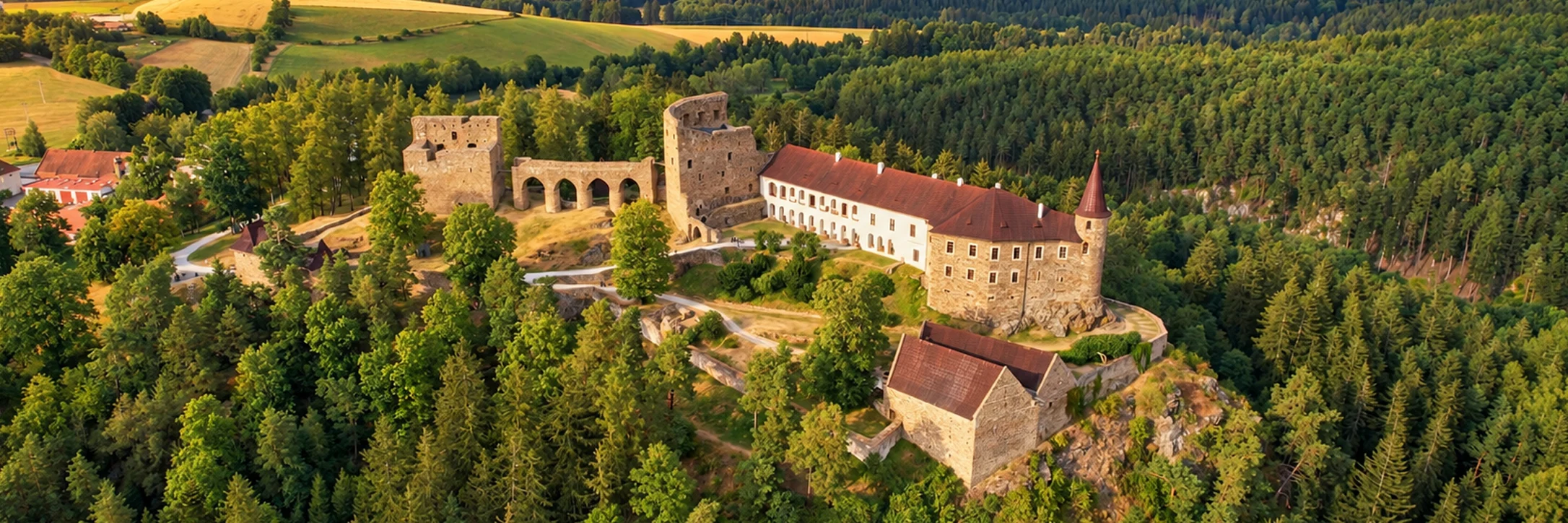
Hrad Kašperk / Burg Kašperk
Hrad Rabí / Burg Rabí
Pražský hrad / Prager Burg